2026 Legislative Action Page

Email Olivia Zink ([email protected]) with edits, errors, or questions to this page

HB = House Bill      House Sign in Instructions HERE            LOB = Legislative Office Building 

SB = Senate Bill     Senate Sign in Instructions HERE           If you have issues signing in, email: [email protected]

Link to Sign in on Senate bills

Link to Sign in on House Bills 

Progress of all bills at the bottom of the page.

Bills we're tracking:


Jan 26-30

Support or Oppose? Bill

Action *Click for Links*

Support

ThumbsUp.png


HB1627

creating a single primary ballot. 

Public Hearing: 1/27/26 at 10:00 a.m. 
Location: 1 Granite Place Room 158
Committee: House Election Law
 

Link to Sign in on House Bills 

Oppose

ThumbsDown.png


HB1520

defining citizenship for the purposes of voting.

Public Hearing: 1/27/26 at 10:20 a.m. 
Location: 1 Granite Place Room 158
Committee: House Election Law
 

Link to Sign in on House Bills 

Link to Email House Election Law Committee

NHCVR Talking Points

Oppose

ThumbsDown.png


HB1382

relative to proof of citizenship for overseas voters voting under the Uniformed and Overseas Citizens Absentee Voting Act.

Public Hearing: 1/27/26 at 10:40 a.m. 
Location: 1 Granite Place Room 158
Committee: House Election Law

Link to Sign in on House Bills 

Link to Email House Election Law Committee

NHCVR Talking Points

Oppose

ThumbsDown.png


CACR21

relating to voting eligibility.

Public Hearing: 1/27/26 at 11:20 a.m. 
Location: 1 Granite Place Room 158
Committee: House Election Law

Link to Sign in on House Bills 

Oppose

ThumbsDown.png


HB1106

requiring the public disclosure of the citizenship of a candidate for public office.

Public Hearing: 1/27/26 at 11:40 a.m. 
Location: 1 Granite Place Room 158
Committee: House Election Law

Link to Sign in on House Bills 

Oppose

ThumbsDown.png


HB1396

relative to vacancies in state offices.

Public Hearing: 1/27/26 at 1:00p.m.
Location: 1 Granite Place Room 158
Committee: House Election Law

Link to Sign in on House Bills 


Jan 19-23

Support or Oppose? Bill

Action *Click for Links*

Support

ThumbsUp.png

SB437

making a line on the return that enumerates the number of people who attempted to register to vote but were denied registration due to lack of required documentation.

Public Hearing: 1/20/26 at 9:15 a.m. 
Location: State House Room 122-123
Committee: Senate Election Law

Link to Email Senate Committee

Support

ThumbsUp.png

SB438

enabling the department of safety and the secretary of state to develop a process to share certain information regarding REAL ID applicants.

Public Hearing: 1/20/26 at 9:15 a.m. 
Location: State House Room 122-123
Committee: Senate Election Law

Link to Email Senate Committee


Oppose

ThumbsDown.png

HB1300

changing the state's congressional districts.

Public Hearing: 1/20/26 at 10:00 a.m. 
Location: 1 Granite Place Room 158
Committee: House Election Law

Link to Sign in on House Bills 

No position; Raises concerns about local control

HB1300

non-germane Amendment 2026-0093h to cap local property taxes

Public Hearing: 1/20/26 at 10:15 a.m. 
Location: 1 Granite Place Room 158
Committee: House Election Law

Link to Sign in on House Bills 

Support

ThumbsUp.png

HB1487

creating an independent commission to propose redistricting maps for the legislature to consider.

Public Hearing: 1/20/26 at 10:20 a.m. 
Location: 1 Granite Place Room 158
Committee: House Election Law

Link to Sign in on House Bills 

Oppose

ThumbsDown.png

HB1284

requiring the inclusion of a voter's year of birth on the voter checklist.

Public Hearing: 1/20/26 at 11:00 a.m. 
Location: 1 Granite Place Room 158
Committee: House Election Law

Link to Sign in on House Bills 

Oppose

ThumbsDown.png

HB1342

restricting access to certain information relative to voters subject to the Uniformed and Overseas Citizens Absentee Voting Act

Public Hearing: 1/20/26 at 11:45 a.m. 
Location: 1 Granite Place Room 158
Committee: House Election Law

Link to Sign in on House Bills 

Support

ThumbsUp.png

HB1678

requiring the secretary of state to accept voter registration forms directly from voters and to create an online portal for direct voter registration.

Public Hearing: 1/20/26 at 1:00 p.m.
Location: 1 Granite Place Room 158
Committee: House Election Law

Link to Sign in on House Bills 

Support

ThumbsUp.png

HB1600

requiring the division of motor vehicles to make available the opportunity to register to vote at the time of application for or renewal of a drivers license or nondrivers identification card.

Public Hearing: 1/20/26 at 1:20 p.m. 
Location: 1 Granite Place Room 158
Committee: House Election Law

Link to Sign in on House Bills 

Support

ThumbsUp.png

HB1081

requiring political committees to certify with the secretary of state whether they have, or anticipate having, less than $1,000 in receipts or expenditures in an election cycle.

Public Hearing: 1/20/26 at 1:50 p.m.
Location: 1 Granite Place Room 158
Committee: House Election Law

Link to Sign in on House Bills 

Support

ThumbsUp.png

HB1083

requiring the disclosure of the source of certain political donations in state elections.

Public Hearing: 1/20/26 at 2:15 p.m.
Location: 1 Granite Place Room 158
Committee: House Election Law

Link to Sign in on House Bills 

Support

ThumbsUp.png

HB1201

requiring certain political committees to disclose the identity of their donors

Public Hearing: 1/20/26 at 2:30 p.m.
Location: 1 Granite Place Room 158
Committee: House Election Law

Link to Sign in on House Bills 

Support

ThumbsUp.png

HB1838

establishing a voter-owned elections fund and commission and raising vehicle registration fees.

Public Hearing: 1/20/26 at 2:45 p.m.
Location: 1 Granite Place Room 158
Committee: House Election Law

Link to Sign in on House Bills 

  • Latest from the blog

    Legislative Hearings March 2026

    Legislative hearings often focus on policy language and process, but behind every bill, there are real people navigating complex lives and systems. During this session, I spent many hours preparing testimony aimed at bridging that gap by translating administrative details into the lived experience of voters across New Hampshire.

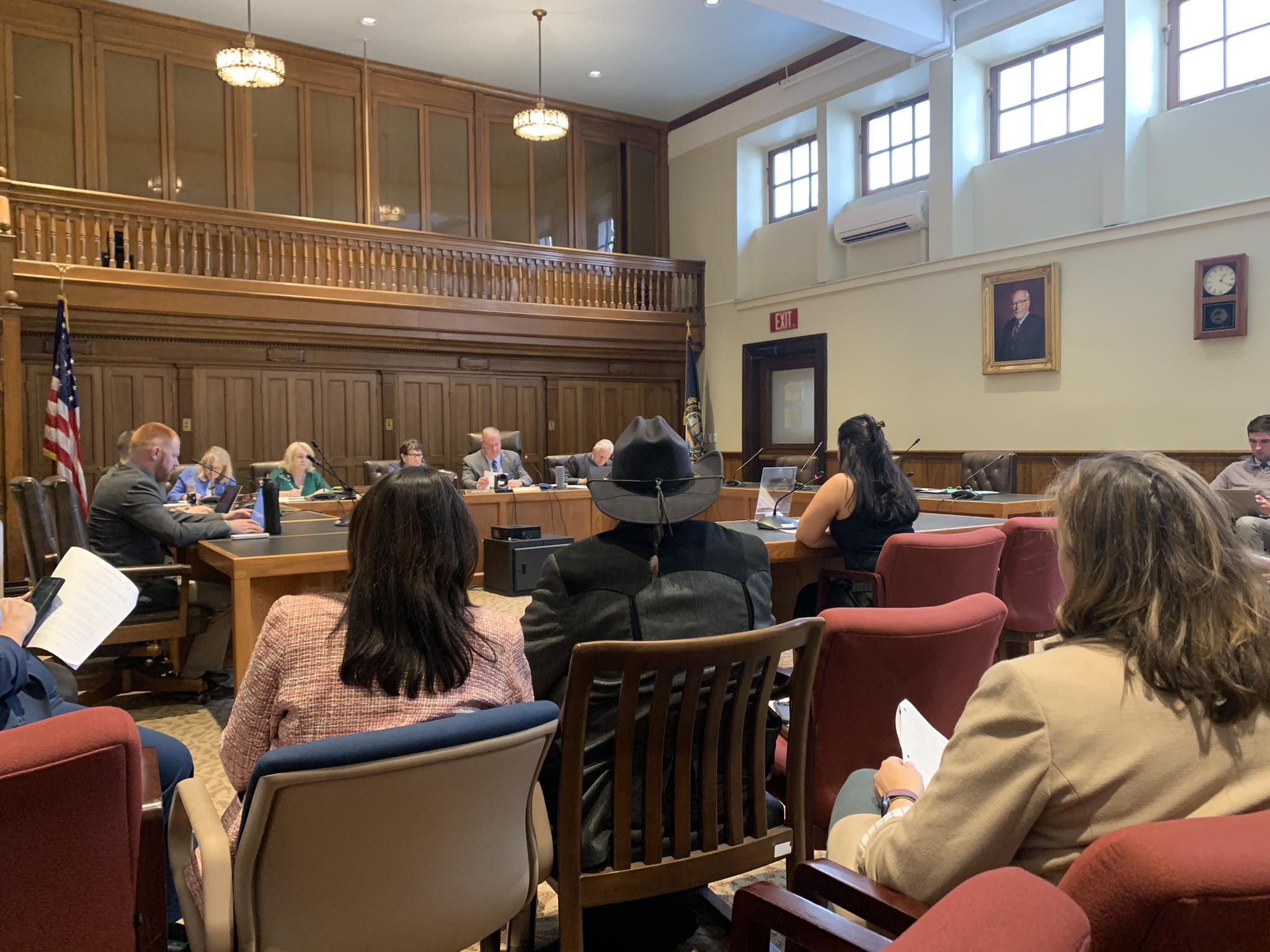
    This session, I have had the opportunity to testify on 12 separate bills before both the House and Senate Election Law Committees. The bills ranged from creating a single-ballot system in New Hampshire and establishing an independent redistricting commission, to eliminating student IDs as valid identification at the polls and redefining what it means to be a “citizen” of New Hampshire for voting purposes.

    Many of these bills shared a common undertone: a concern that New Hampshire’s elections are not sufficiently secure and may be vulnerable to interference. Yet despite this newfound loud cry of interference, there is no evidence of widespread, or even localized, voter fraud in our state. While many proposals were framed as safeguards, several would ultimately make it harder for eligible voters to participate, transforming a largely theoretical and non-existent problem into a real barrier to access.

    One bill, HB 1600, which I testified in support of, passed the House with sweeping bipartisan support. This bill requires the Division of Motor Vehicles to provide the opportunity to register to vote when residents apply for or renew a driver’s license or non-driver identification card. Sponsored by a Democrat and co-sponsored by a Republican, the bill’s bipartisan backing strengthened its chances of moving forward. HB 1600 brings New Hampshire closer to modernizing voter access by meeting people where they already are. As I stated in my testimony, “HB 1600 strengthens our democracy by promoting citizen participation. Our elections are only as representative as the number of eligible persons who can realistically access the process. DMV registration, paired with same-day registration, ensures the greatest number of qualified voters can take part in free and fair elections.” The advancement of this bill represents a meaningful step toward expanding participation.

    Another bill I supported, HB 1201, would have required certain political committees to disclose the identity of their donors. Currently, some nonprofit organizations can contribute significant funds to political campaigns without public disclosure. This can result in substantial financial influence occurring without voters knowing who is behind it.

    HB 1201 aimed to strengthen public trust by applying transparency standards consistently, regardless of political ideology. I offered testimony drawing on arguments from across the political spectrum, emphasizing that transparency benefits voters of all viewpoints. Despite these efforts, the bill was ultimately killed in committee, a reminder that proposals focused on disclosure and accountability often face significant
    resistance.

    I also testified in opposition to several bills. One of the most notable was HB 1520, which sought to redefine citizenship for voting purposes, while introducing an oath of allegiance to the state. The proposal raised concerns ranging from confusing terminology, such as the concept of proving one is a “citizen of New Hampshire,” to an estimated fiscal impact of at least $2.5 million. 

    The bill reflected a recurring pattern this session: proposals that would increase administrative burden and cost in the name of election security without clear evidence of a corresponding problem. In a state where elections are often decided by small margins, even modest barriers can have meaningful consequences. Following a public hearing that drew significant opposition, the sponsor ultimately withdrew the bill, but not before remarking that “it's embarrassing the lack of civics understanding that those comments reflect.” The conversation surrounding this bill highlighted how differently lawmakers and advocates sometimes assess the balance between access and security. 

    Another bill I opposed, HB 323, advanced through the Senate Election Law Committee. This bill requires presentation of government-issued photographic identification to vote and removes student IDs from the list of acceptable forms of identification at the polls. This change creates a disconnect between registration and voting requirements. A student may use a school-issued ID to register to vote, yet that same ID cannot be used to verify identity when casting a ballot on Election Day. Policies that introduce this kind of inconsistency can create confusion and additional hurdles, particularly for younger
    voters and students navigating the process for the first time.

    Policy debates often center on intent, but access is determined by logistics. Every bill I have worked on this session has offered an opportunity to better understand how policy intent translates, or sometimes fails to translate, into real-world impact. In testimony, I tried to engage with sponsors’ goals while also highlighting the practical implications for voters, administrators, and communities.

    This session has reinforced that legislative advocacy is rarely defined by a single outcome. Some proposals move forward, others stall, and many conversations continue beyond the hearing room. Preparation matters even when every point is not raised, and progress often happens incrementally. The work is cumulative and continuing to show up, learn, and engage remains essential. 

    Continue reading → See all posts

Showing 1 reaction

Please check your e-mail for a link to activate your account.
  • Kaylie Efstratiou
    published this page in Take Action 2026-01-16 15:15:33 -0500